Time and Tides

SATB and Organ

c. 32′

Time and Tides was commissioned by Eltham Choral Society, and they gave the premiere in July 2024 at St Alfège Chuch in Greenwich, directed by Max Barley and accompanied by Matthew Jorysz.

The work is an exploration of Greenwich, where Eltham Choral Society is based, and each movement takes a different Greenwich-related theme. There is also an overarching theme of time conveyed through both the texts and the musical motifs. In the first movement, one of the lines of text reads ‘a time to be born and a time to die’, and the subsequent movements play out this narrative, following a trajectory of themes from birth to death.

The second movement is about Queen Elizabeth I when she was a young ‘queen of twenty’. Queen Elizabeth I was born in Greenwich, so this movement represents birth/youth. The third movement is a sea shanty, a type of work song sung during monotonous, repetitive and rhythmic jobs on ships. This represents adulthood, as does the fourth movement which is again about Queen Elizabeth I, but when she was older and ‘plan’d for Britain’s good’.

The fifth movement is split into two distinct sections; in the first section, the studying/working aspect of adulthood is predominant. However, in the second section, it is as if the narrator of the poem has gained wisdom in his later adulthood. The sixth movement wraps up this trajectory: the text is about old age and death, yet it does not end sadly or uncertainly, but with very true faith and trust in God. Despite being about death, this movement, and thus the whole work, ends with a tangible feeling of peace and hope.

Throughout the piece, both rhythmic and melodic motifs have been used to represent the passage of time. The melodic motif, which is also sometimes used harmonically and is transposed depending on the key, sounds like a bell chime; and the rhythmic motif is the word ‘TIME’ spelt out in Morse code: _  ..  _ _  .

Individual movements, along with a short explanation of their Greenwich-related theme, can be found here:

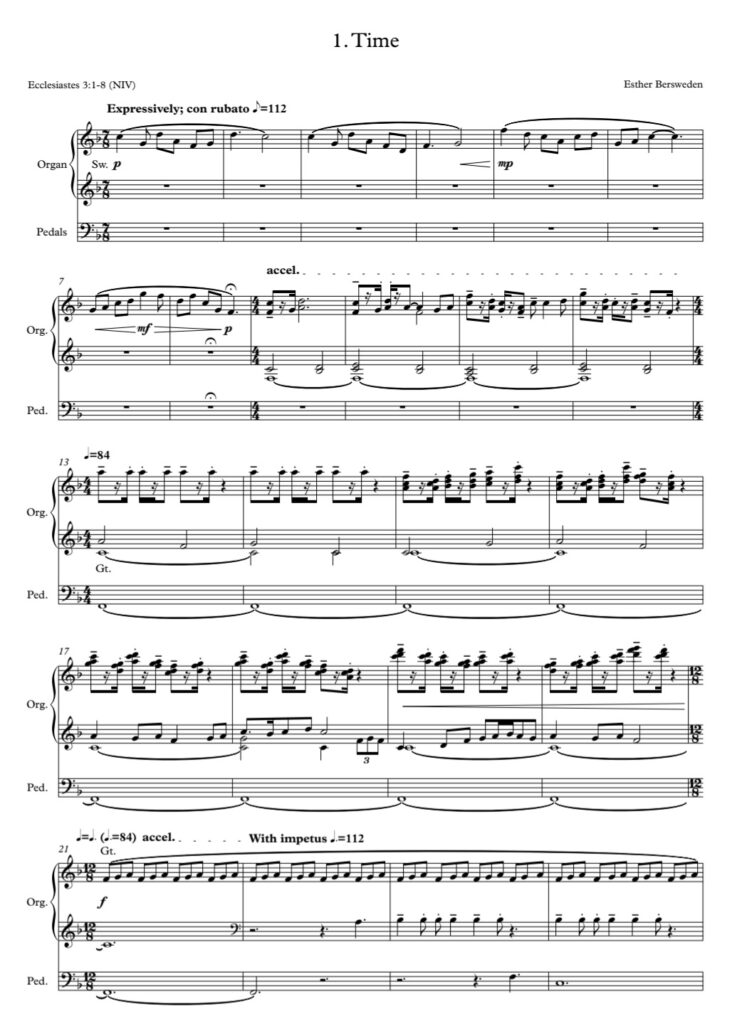
I. Time: Time (Greenwich Mean Time)

The first and last movements bookend the music by both having time as their Greenwich-related theme. This strengthens the overarching theme of time, and allows the listener to arrive back at the opening theme but seen and felt in a different way.

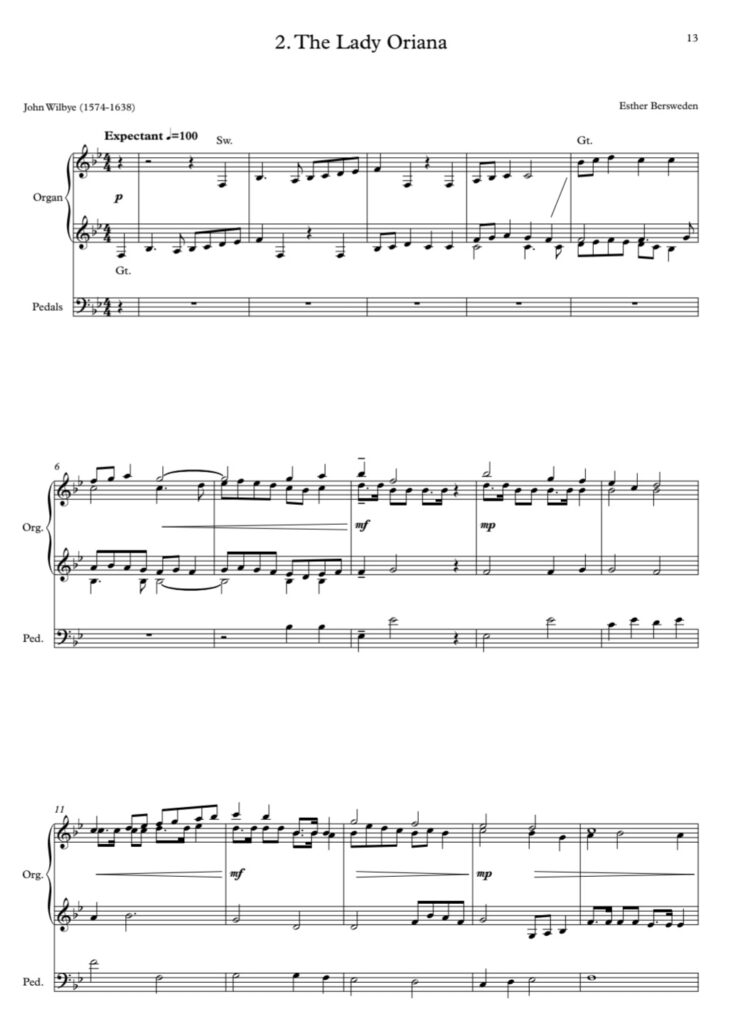
II. The Lady Oriana: Royalty (Queen Elizabeth I)

‘The Lady Oriana’ refers to Queen Elizabeth I, who was born at Greenwich Palace. This movement makes use of a polyphonic style reminiscent of music from the Renaissance period; Thomas Tallis (1505-1585) was one of the most noted composers of his time, and he is allegedly buried in St. Alfège Churchyard.

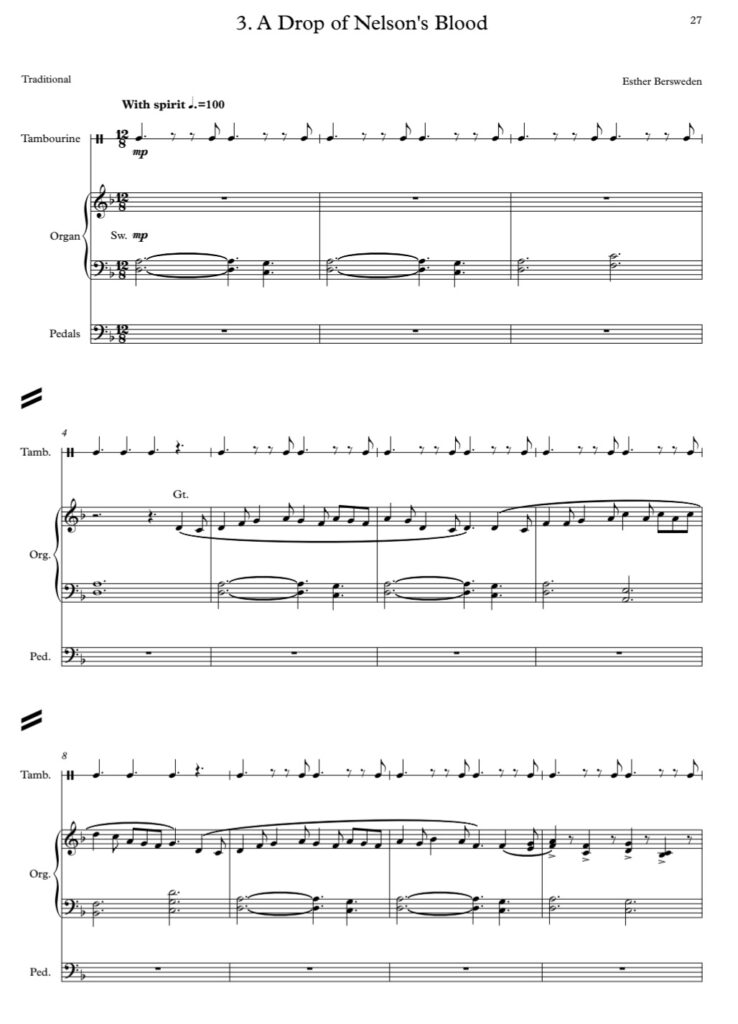
III. A Drop of Nelson’s Blood: Maritime Links

Greenwich has a rich history of ties with the navy and the sea, playing host to the National Maritime Museum, the Old Royal Naval College and the Cutty Sark. Lord Nelson’s body lay in state in Greenwich Hospital for three days when he was brought back to England in 1805, making the choice of text for the sea shanty in the third movement an easy one: ‘A drop of Nelson’s blood wouldn’t do us any harm’.

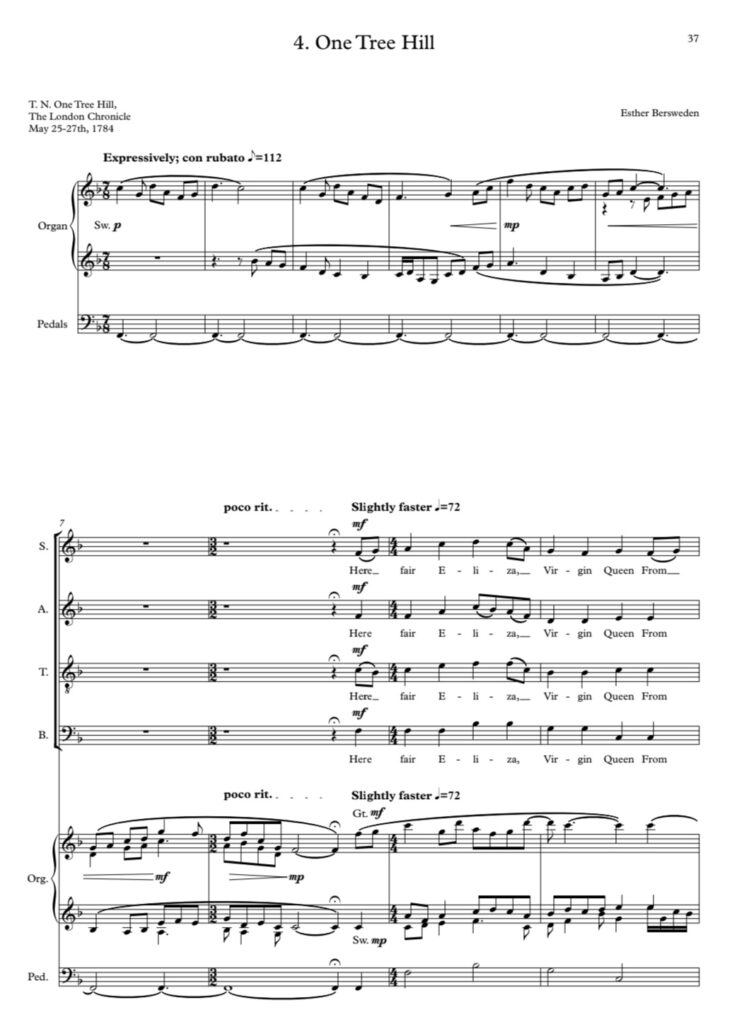
IV. One Tree Hill: Nature (Greenwich Park)

The fourth movement combines the themes of nature and royalty. The text of this movement is about ‘Fair Eliza’ – once again referring to Queen Elizabeth I. This text is inscribed on a bench on One Tree Hill in Greenwich Park, with an expansive view across the city. Once the two verses of text have been sung, the organ takes over for a pastoral-like reflection on the melody which has been introduced by the choir.

V. When I Heard the Learn’d Astronomer: Astronomy (The Royal Observatory)

The Royal Observatory was established in 1675, making 2025 its 350th anniversary. This movement sets a poem by Walt Whitman (1819-1892) about an astronomer who, having spent too long inside a lecture room talking and learning about the stars and planets, goes outside to gaze at them in awe and wonder – experiencing them for himself.

VI. Even Such is Time: Time

Alongside its theme of time, the sixth movement has further links with Greenwich: the text was written by Sir Walter Raleigh (1552-1618), who held various political positions during the reign of Queen Elizabeth I. There is a statue of him near the Old Royal Naval College in Greenwich.

This Joyful Eastertide

This is an arrangement of the setting by Charles Wood (1866-1926).

SATB, splits up to SSAATTB

c. 4’05”

Commissioned by Joe Cryan and St Mary Redcliffe, Bristol, for the 2025 Easter morning service, broadcast on BBC 1

Performed by the Choir at St Mary Redcliffe, Bristol, directed by Joe Cryan, 2025. Broadcast on BBC 1 as part of the Easter morning service.

This joyful Eastertide,
Away with sin and sorrow!
My Love, the Crucified,
Hath sprung to life this morrow.

Had Christ, that once was slain,
Ne’er burst his three-day prison,
Our faith had been in vain:
But now hath Christ arisen.

My flesh in hope shall rest,
And for a season slumber:
Till trump from east to west
Shall wake the dead in number.

Had Christ…

Death’s flood hath lost his chill,
Since Jesus cross’d the river:
Lover of souls from ill
My passing soul deliver.

Had Christ…

G. R. Woodward (1848-1934)

If you would like to perform this piece, please get in touch via the Contact pageI am happy to send perusal scores if interest is expressed.
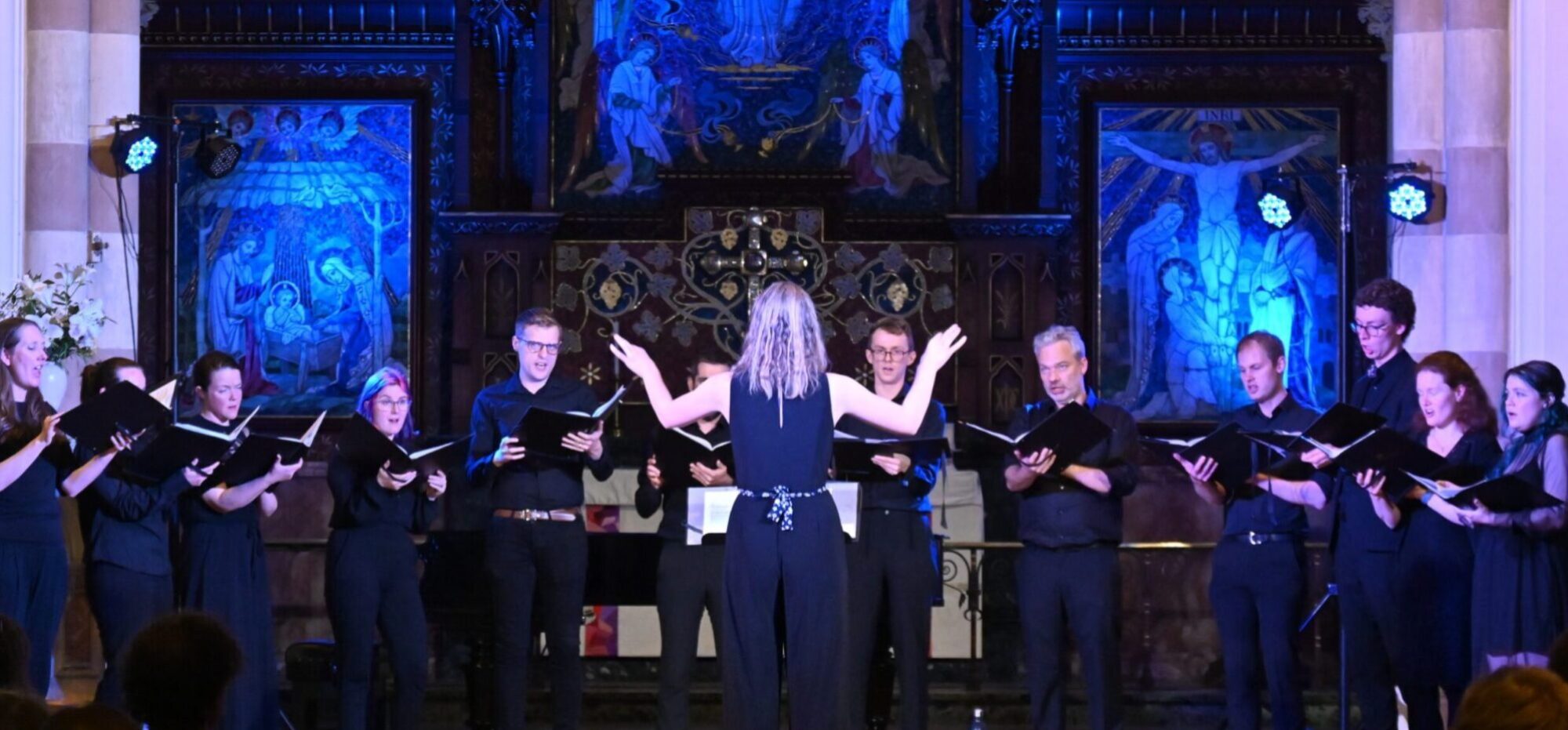
The Sun Has Set

SATB with Alto Solo, splits up to SSATTB

c. 6’20”

Performed by Avon Chamber Choir, directed by Esther Bersweden, 2024

The sun has set, and the long grass now
Waves dreamily in the evening wind;
And the wild bird has flown from that
old gray stone
In some warm nook a couch to find.

In all the lonely landscape round
I see no light and hear no sound,
Except the wind that far away
Come sighing o’er the healthy sea.

Emily Brontë (1818-1848)

My God, my God, why have you forsaken me?
Why are you so far from saving me,
so far from my cries of anguish?
My God, I cry out by day, but you do not answer, by night, but I find no rest.

Psalm 22:1-2

I call on the Lord in my distress,
and he answers me.

Psalm 120:1

If you would like to perform this piece, please get in touch via the Contact pageI am happy to send perusal scores if interest is expressed.

The Owl and the Pussy-Cat

This is the version for SAB. If you would like to see the versions for SSA or SATB, please click here:
SSA
SATB

SAB and Piano

c. 3’50”

The Owl and the Pussy-cat went to sea
In a beautiful pea-green boat,
They took some honey, and plenty of money,
Wrapped up in a five-pound note.
The Owl looked up to the stars above,
And sang to a small guitar,
“O lovely Pussy! O Pussy, my love,
What a beautiful Pussy you are,
You are,
You are!
What a beautiful Pussy you are!”

Pussy said to the Owl, “You elegant fowl!
How charmingly sweet you sing!
O let us be married! too long we have tarried:
But what shall we do for a ring?”
They sailed away, for a year and a day,
To the land where the Bong-Tree grows
And there in a wood a Piggy-wig stood
With a ring at the end of his nose,
His nose,
His nose,
With a ring at the end of his nose.

“Dear Pig, are you willing to sell for one shilling
Your ring?” Said the Piggy, “I will.”
So they took it away, and were married next day
By the Turkey who lives on the hill.
They dined on mince, and slices of quince,
Which they ate with a runcible spoon;
And hand in hand, on the edge of the sand,
They danced by the light of the moon,
The moon,
The moon,
They danced by the light of the moon.

Edward Lear (1812-1888)

If you would like to perform this piece, please get in touch via the Contact pageI am happy to send perusal scores if interest is expressed.
The Owl and the Pussy-Cat

This is the version for SATB. If you would like to see the versions for SSA or SAB, please click here:
SSA
SAB

SATB and Piano

c. 3’50”

The Owl and the Pussy-cat went to sea
In a beautiful pea-green boat,
They took some honey, and plenty of money,
Wrapped up in a five-pound note.
The Owl looked up to the stars above,
And sang to a small guitar,
“O lovely Pussy! O Pussy, my love,
What a beautiful Pussy you are,
You are,
You are!
What a beautiful Pussy you are!”

Pussy said to the Owl, “You elegant fowl!
How charmingly sweet you sing!
O let us be married! too long we have tarried:
But what shall we do for a ring?”
They sailed away, for a year and a day,
To the land where the Bong-Tree grows
And there in a wood a Piggy-wig stood
With a ring at the end of his nose,
His nose,
His nose,
With a ring at the end of his nose.

“Dear Pig, are you willing to sell for one shilling
Your ring?” Said the Piggy, “I will.”
So they took it away, and were married next day
By the Turkey who lives on the hill.
They dined on mince, and slices of quince,
Which they ate with a runcible spoon;
And hand in hand, on the edge of the sand,
They danced by the light of the moon,
The moon,
The moon,
They danced by the light of the moon.

Edward Lear (1812-1888)

If you would like to perform this piece, please get in touch via the Contact pageI am happy to send perusal scores if interest is expressed.
The Owl and the Pussy-Cat

This is the version for SSA. If you would like to see the versions for SATB or SAB, please click here:
SATB
SAB

SSA and Piano

c. 3’50”

The Owl and the Pussy-cat went to sea
In a beautiful pea-green boat,
They took some honey, and plenty of money,
Wrapped up in a five-pound note.
The Owl looked up to the stars above,
And sang to a small guitar,
“O lovely Pussy! O Pussy, my love,
What a beautiful Pussy you are,
You are,
You are!
What a beautiful Pussy you are!”

Pussy said to the Owl, “You elegant fowl!
How charmingly sweet you sing!
O let us be married! too long we have tarried:
But what shall we do for a ring?”
They sailed away, for a year and a day,
To the land where the Bong-Tree grows
And there in a wood a Piggy-wig stood
With a ring at the end of his nose,
His nose,
His nose,
With a ring at the end of his nose.

“Dear Pig, are you willing to sell for one shilling
Your ring?” Said the Piggy, “I will.”
So they took it away, and were married next day
By the Turkey who lives on the hill.
They dined on mince, and slices of quince,
Which they ate with a runcible spoon;
And hand in hand, on the edge of the sand,
They danced by the light of the moon,
The moon,
The moon,
They danced by the light of the moon.

Edward Lear (1812-1888)


If you would like to perform this piece, please get in touch via the Contact page
I am happy to send perusal scores if interest is expressed.
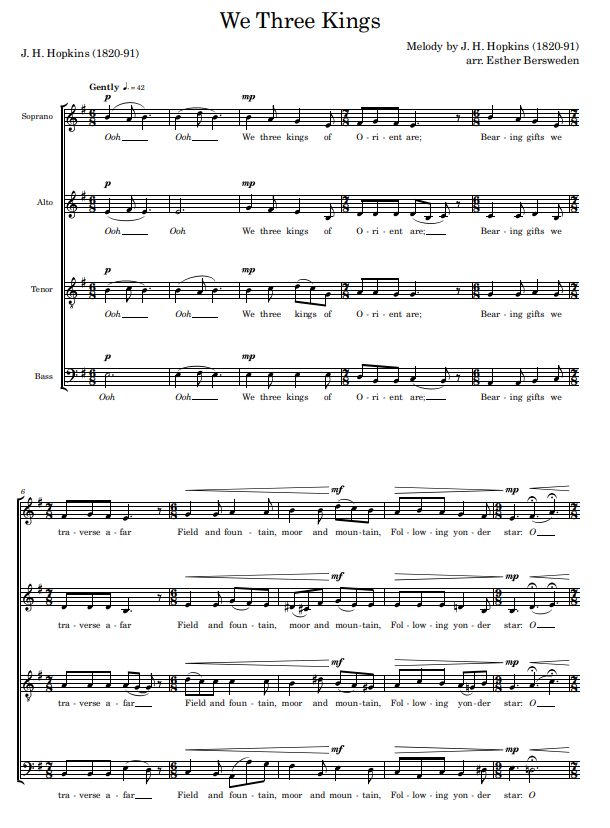
The Mock Turtle’s Song

SSAATTBB

c. 4’05”

Commissioned for the National Youth Choir Fellowship Ensemble

‘Will you walk a little faster?’ said a whiting to a snail.
‘There’s a porpoise close behind us, and he’s treading on my tail.
See how eagerly the lobsters and the turtles all advance!
They are waiting on the shingle – will you come and join the dance?
Will you, won’t you, will you, won’t you, will you join the dance?
Will you, won’t you, will you, won’t you, won’t you join the dance?

‘You can really have no notion how delightful it will be
When they take us up and throw us, with the lobsters, out to sea!’
But the snail replied, ‘Too far, too far!’ and gave a look askance –
Said he thanked the whiting kindly, but he would not join the dance.
Would not, could not, would not, could not, would not join the dance.
Would not, could not, would not, could not, could not join the dance.

‘What matters it how far we go?’ his scaly friend replied.
‘There is another shore, you know, upon the other side.
The further off from England the nearer is to France –
Then turn not pale, beloved snail, but come and join the dance.
Will you, won’t you, will you, won’t you, will you join the dance?
Will you, won’t you, will you, won’t you, won’t you join the dance?’

Lewis Carroll (1832–1898)
From Alice in Wonderland

This piece will be published soon – keep an eye out!

The Lord is my Shepherd

SATB

c. 3’25”

Performed by Clifton Cathedral Choir, directed by David Bednall, 2023

The Lord is my shepherd:
Therefore can I lack nothing.
He shall feed me in a green pasture:
And lead me forth beside the waters of comfort.
He shall convert my soul:
And bring me forth in the paths of righteousness for His Name’s sake.
Yea though I walk through the valley of the shadow of death I will fear no evil:
For Thou art with me, thy rod and thy staff comfort me.
Thou shalt prepare a table before me against them that trouble me
Thou hast anointed my head with oil and my cup shall be full.
But Thy loving kindness and mercy shall follow me all the days of my life
And I will dwell in the house of the Lord for ever.

Psalm 23

If you would like to perform this piece, please get in touch via the Contact pageI am happy to send perusal scores if interest is expressed.
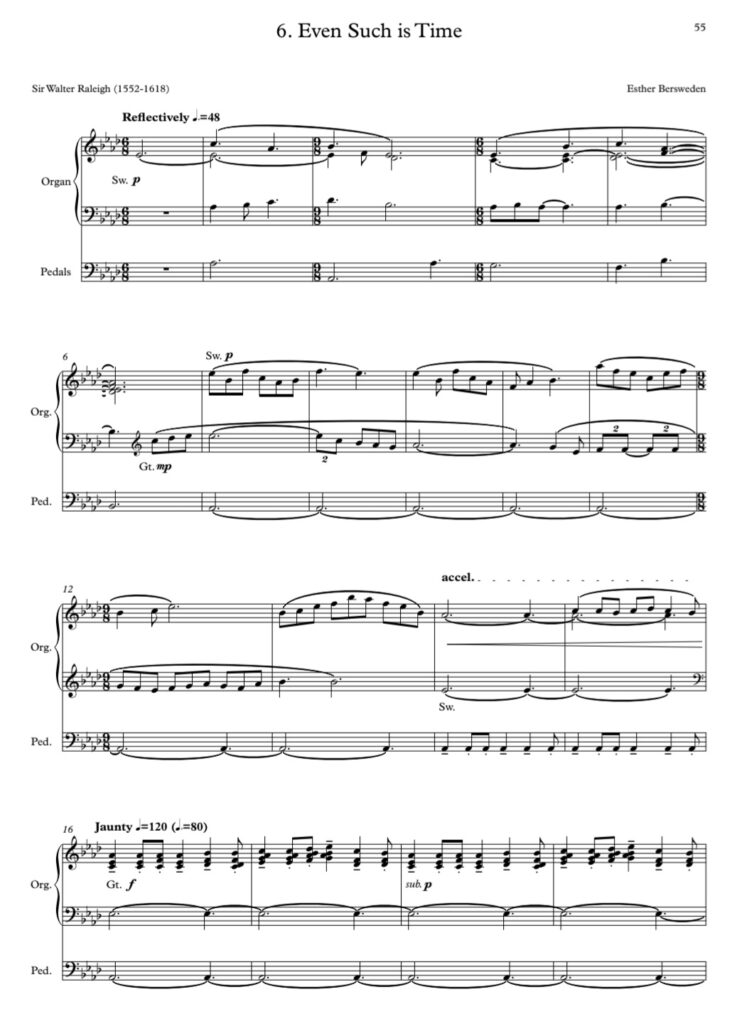
The Life of the World

SA and Piano/Organ

3’20”

Commissioned by the RSCM for the York Young Voices Festival 2024

Performed by the Choristers at the RSCM Bath Choral Course, directed by Emma Gibbins, 2024. Organ: Nicholas Freestone

Oh the life of the world is a joy and a treasure,
unfolding in beauty the green growing tree,
the changing of seasons in mountain and valley
the stars and the bright restless sea.

Oh the life of the world is a fountain of goodness
overflowing in labour and passion and pain,
in the sound of the city and the silence of wisdom,
in the birth of a child once again.

Oh the life of the world is the source of our healing.
It rises in laughter and wells up in song;
it springs from the care of the poor and the broken
and refreshes where justice is strong.

So give thanks for the life and give love to the Maker
and rejoice in the gift of the bright risen Son.
And walk in the peace and power of the Spirit
till the days of our living are done.

© Kathy Galloway (1952-2025)

If you would like to perform this piece, please get in touch via the Contact pageI am happy to send perusal scores if interest is expressed.
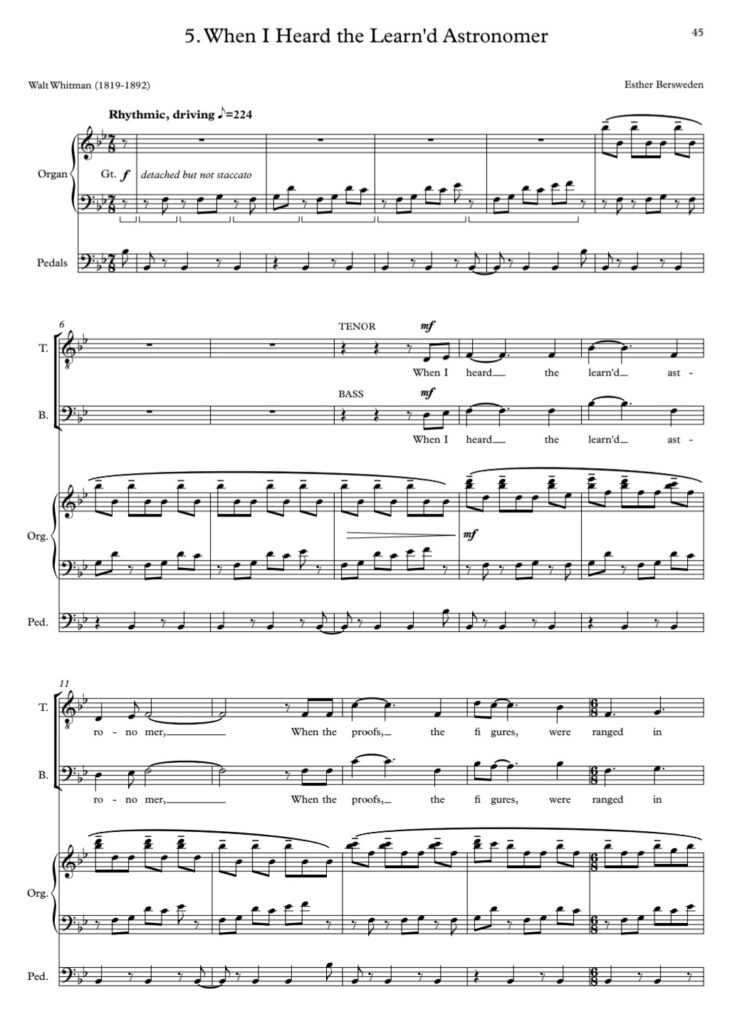
The Lake Isle of Innisfree

SATB with Soprano, Tenor and Baritone Solos, splits up to SATTBB

c. 3’20”

Performed by Avon Chamber Choir, directed by Esther Bersweden, 2025. Soloists: Alex Scott and Peter Waters

I will arise and go now, and go to Innisfree,
And a small cabin build there, of clay and wattles made;
Nine bean-rows will I have there, a hive for the honey-bee,
And live alone in the bee-loud glade.

And I shall have some peace there, for peace comes dropping slow,
Dropping from the veils of the morning to where the cricket sings;
There midnight’s all aglimmer, and noon a purple glow,
And evening full of the linnet’s wings.

I will arise and go now, for always night and day
I hear lake water lapping with low sounds by the shore;
While I stand on the roadway, or on the pavements grey,
I hear it in the deep heart’s core.

W.B. Yeats (1865-1939)

If you would like to perform this piece, please get in touch via the Contact pageI am happy to send perusal scores if interest is expressed.