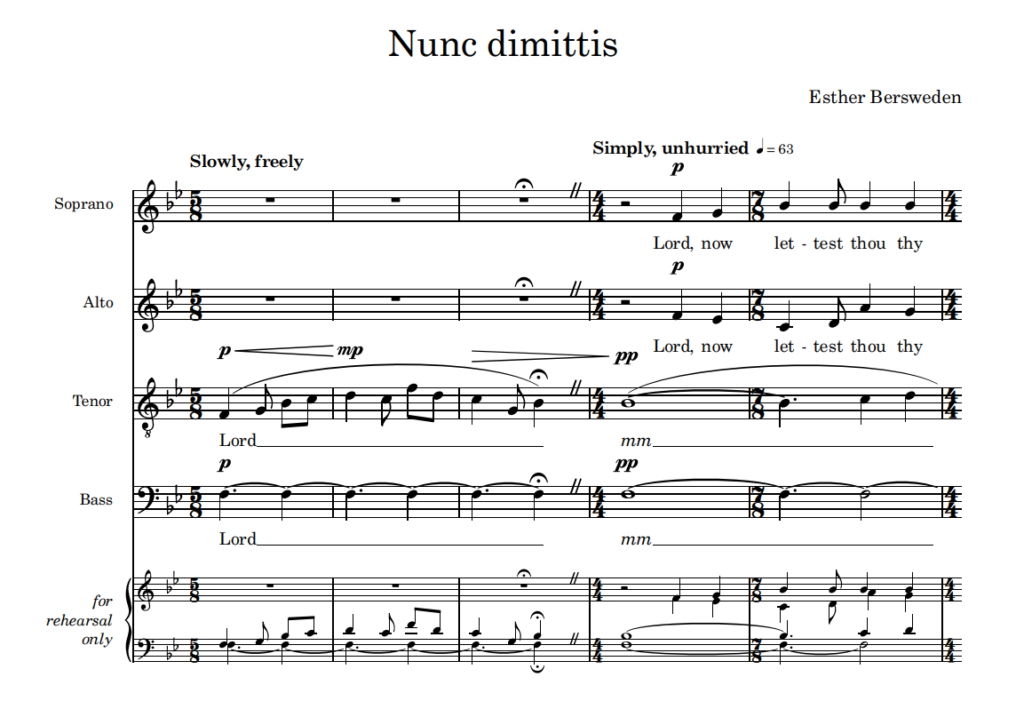
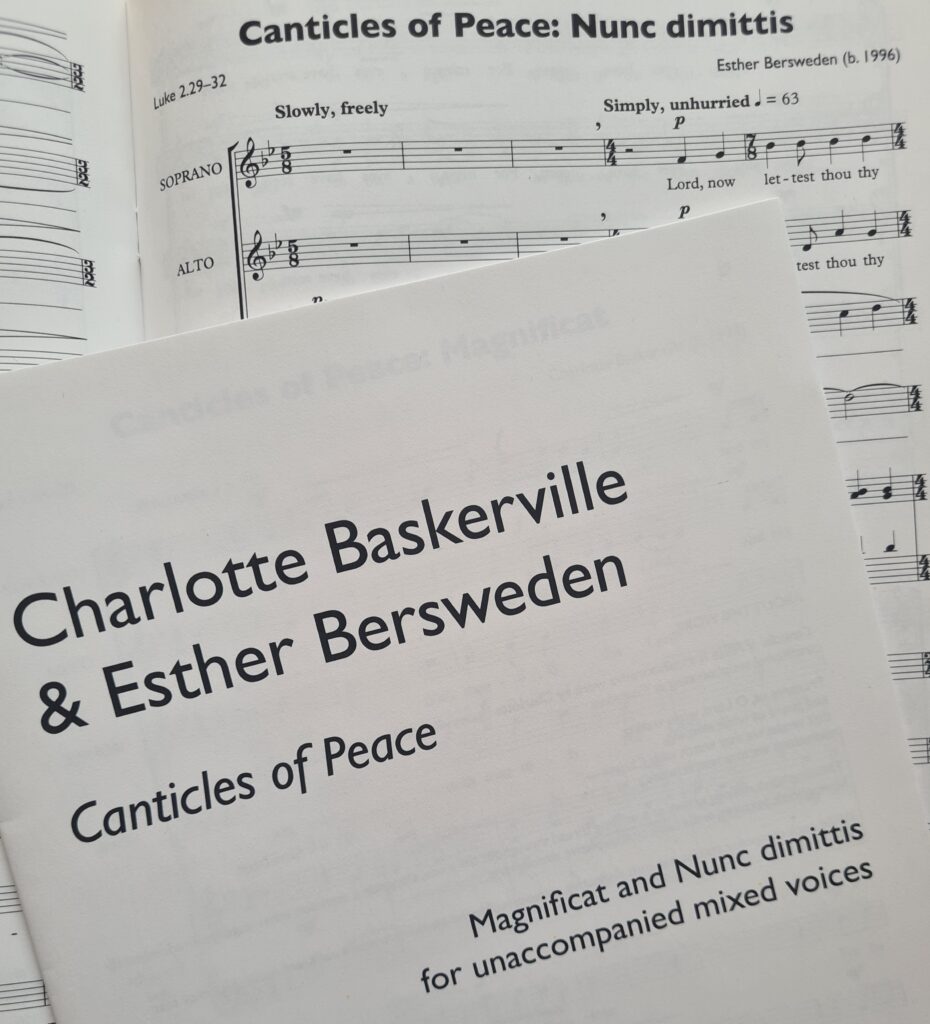
This piece is paired with the Magnificat written by Charlotte Baskerville to form the Canticles of Peace.
SATB
c. 2’40”
Lord, now lettest thou thy servant depart in peace: according to thy word. For mine eyes have seen thy salvation; which thou has prepared: before the face of all people. To be a light to lighten the Gentiles: and to be the glory of thy people Israel.
Glory be to the Father and to the Son: and to the Holy Ghost; As it was in the beginning, is now, and ever shall be: world without end. Amen.
Luke 2:29-32
Canticles of Peace
Published by Encore Publications in 2026, Canticles of Peace contains the Magnificat written by Charlotte Baskerville, and the Nunc dimittis written by Esther Bersweden.
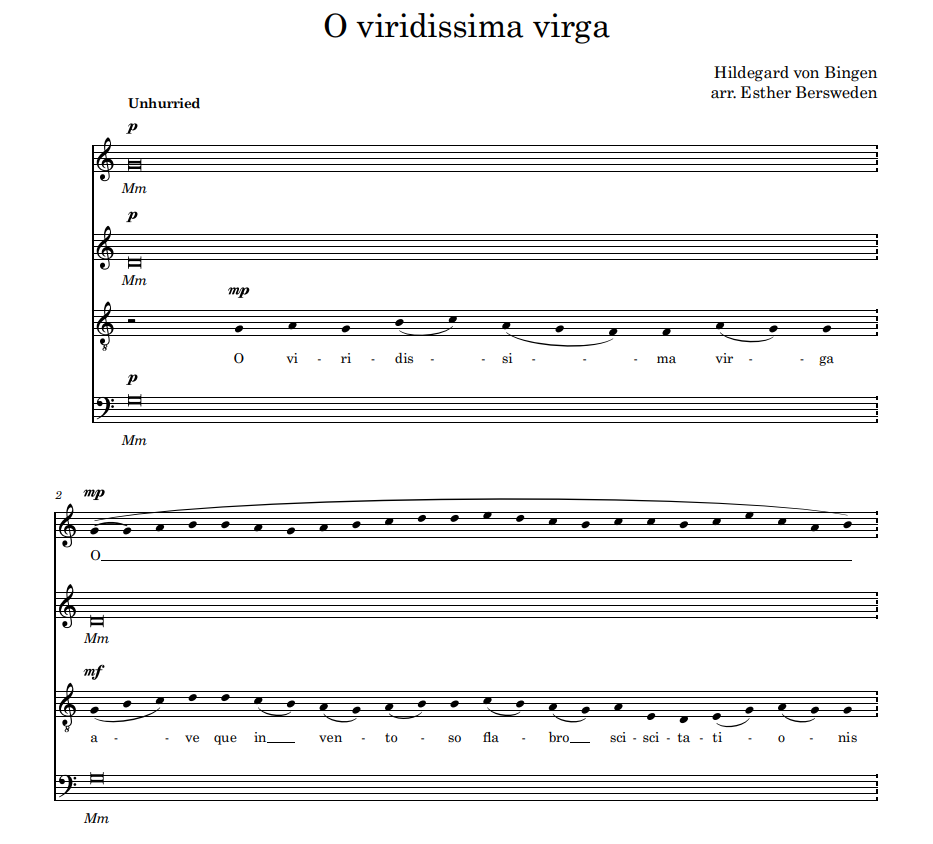
This is an arrangement of the setting by Hildegard von Bingen (1098-1179).
SATB
O viridissima virga, ave, que in ventoso flabro sciscitationis sanctorum prodisti.
Cum venit tempus quod tu floruisti in ramis tuis, ave, ave fuit tibi, quia calor solis in te sudavit sicut odor balsam.
Nam in te floruit pulcher flos qui odorem dedit omnibus aromatibus que arida erant.
Et illa apparuerunt omnia in viriditate plena.
Unde celi dederunt rorem super gramen et omnis terra leta facta est, quoniam viscera ipsius frumentum protulerunt et quoniam volucres celi nidos in ipsa habuerunt.
Deinde facta est esca hominibus et gaudium magnum epulantium. Unde, o suavis Virgo, in te non deficit ullum gaudium.
Hec omnia Eva contempsit.
Nunc autem laus sit Altissimo.
O branch of freshest green, O hail! Within the windy gusts of saints upon a quest you swayed and sprouted forth.
When it was time, you blossomed in your boughs – “Hail, hail!” you heard, for in you seeped the sunlight’s warmth like balsam’s sweet perfume.
For in you bloomed so beautiful a flow’r, whose fragrance wakened all the spices from their dried-out stupor.
And they appeared in full viridity.
Then rained the heavens dew upon the grass and all the earth was cheered, for from her womb she brought forth fruit and for the birds up in the sky have nests in her.
Then was prepared that food for humankind, the greatest joy of feasts! O Virgin sweet, in you can ne’er fail any joy.
All this Eve chose to scorn.
But now, let praise ring forth unto the Highest!
Hildegard von Bingen (1098-1179)
If you would like to perform this piece, please get in touch via the Contact page. I am happy to send perusal scores if interest is expressed.
This is an arrangement of the setting by Hildegard von Bingen (1098-1179).
SATB
c.7′
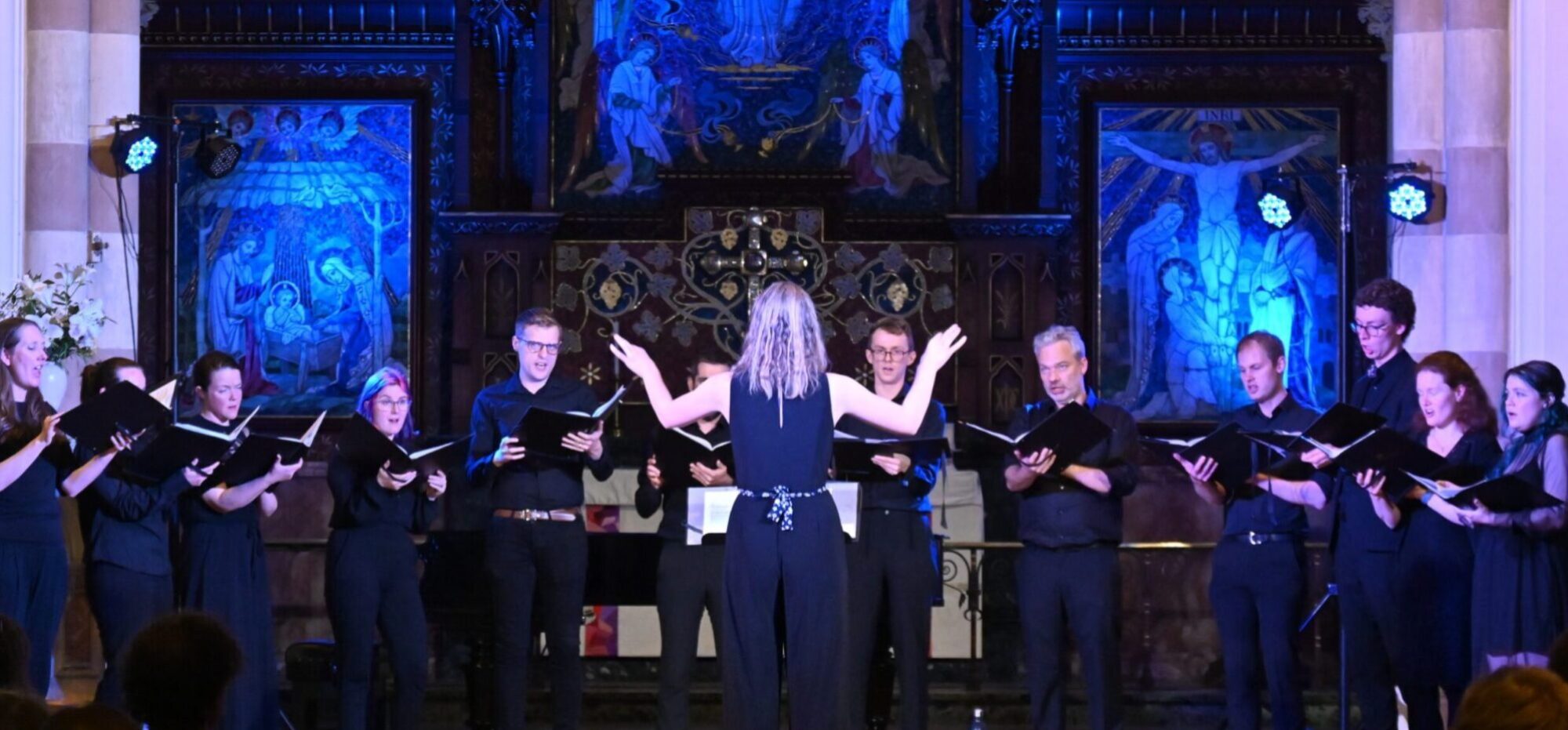
Performed by Avon Chamber Choir and directed by Esther Bersweden, 2026
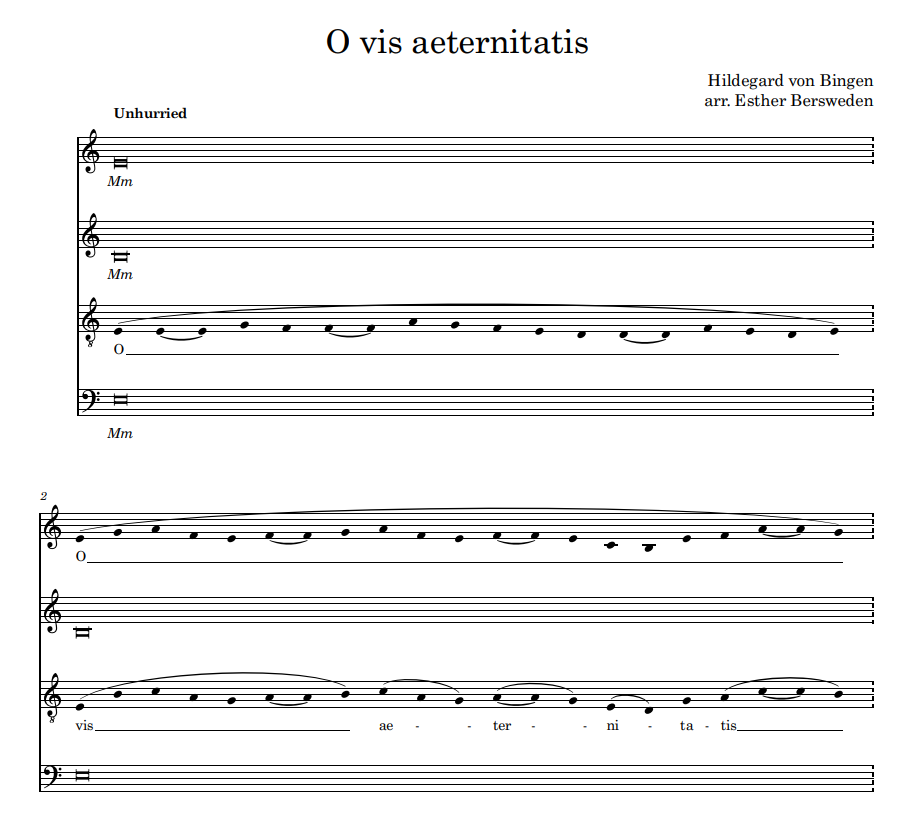
O vis eternitatis que omnia ordinasti in corde tuo, per Verbum tuum omnia creata sunt sicut voluisti, et ipsum Verbum tuum induit carnem in formatione illa que educta est de Adam.
Et sic indumenta ipsius a maximo dolore abstersa sunt.
O quam magna est benignitas Salvatoris, qui omnia liberavit per incarnationem suam, quam divinitas exspiravit sine vinculo peccati.
Et sic indumenta ipsius a maximo dolore abstersa sunt.
Gloria Patri et Filio et Spiritui sancto.
Et sic indumenta ipsius a maximo dolore abstersa sunt.
O power within Eternity: All things you held in order in your heart, and through your Word were all created according to your will. And then your very Word was clothed within that form of flesh from Adam born.
And so his garments were washed and cleansed from greatest suffering. How great the Saviour’s goodness is! For he has freed all things by his own Incarnation, which divinity breathed forth unchained by any sin. And so his garments were washed and cleansed from greatest suffering. Glory be to the Father and to the Son and to the Holy Spirit. And so his garments were washed and cleansed from greatest suffering.
Hildegard von Bingen (1098-1179)
If you would like to perform this piece, please get in touch via the Contact page. I am happy to send perusal scores if interest is expressed.
This is an arrangement of the setting by Hildegard von Bingen (1098-1179).
SATB
c.10′
Performed by Avon Chamber Choir and directed by Esther Bersweden, 2026
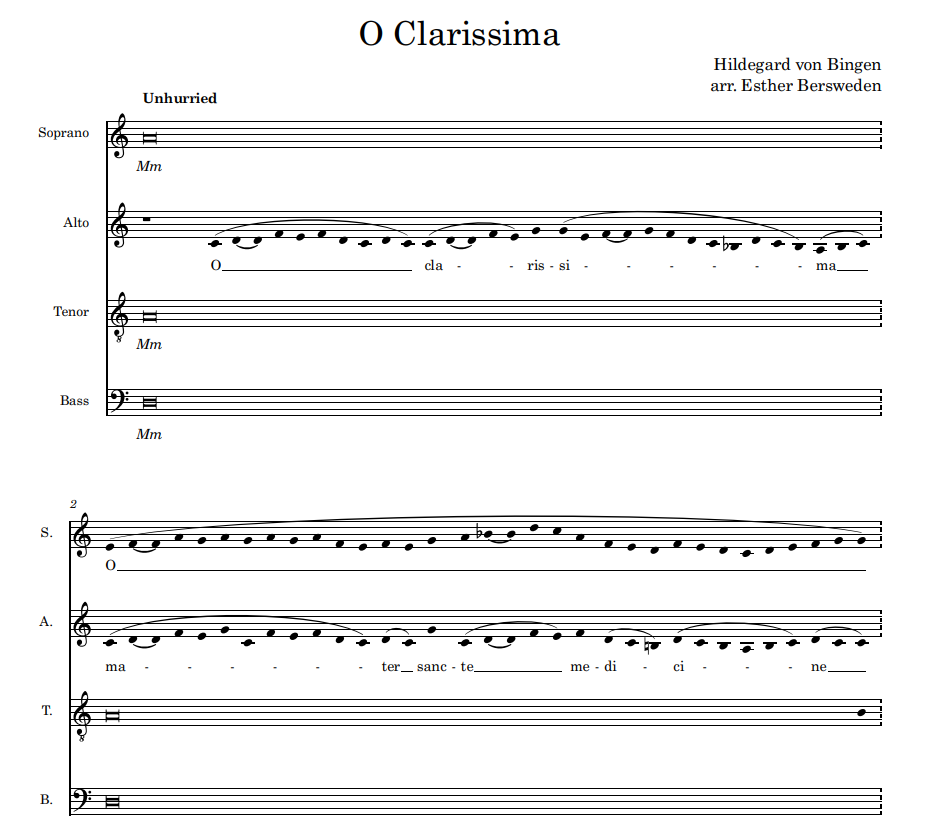
O clarissima mater sancte medicine, tu ungenta per sanctum Filium tuum infudisti in plangentia vulnera mortis, que Eva edificavit in tormenta animarum. Tu destruxisti mortem, edificando vitam.
Ora pro nobis ad tuum natum, stella maris, Maria.
O vivificum instrumentum et letum ornamentum et dulcedo omnium deliciarum, que in te non deficient.
Ora pro nobis ad tuum natum, stella maris, Maria.
Gloria Patri et Filio et Spiritui sancto.
Ora pro nobis ad tuum natum, stella maris, Maria.
O radiant bright, O mother of a holy medicine, your ointments through your holy Son you’ve poured upon the plangent wounds of death, by Eve constructed as torture chambers of the soul. This death you have destroyed by building life.
Pray for us to your child, O sea star Mary.
O instrument of life and joyful ornament, and sweetener of all delights, that in you will not fail.
Pray for us to your child, O sea star Mary.
Glory be to the Father and to the Son and to the Holy Spirit.
Pray for us to your child, O sea star Mary.
Hildegard von Bingen (1098-1179)
If you would like to perform this piece, please get in touch via the Contact page. I am happy to send perusal scores if interest is expressed.
This is an arrangement of the setting by Franz Schubert (1797-1828).
SATB
c. 4’10”
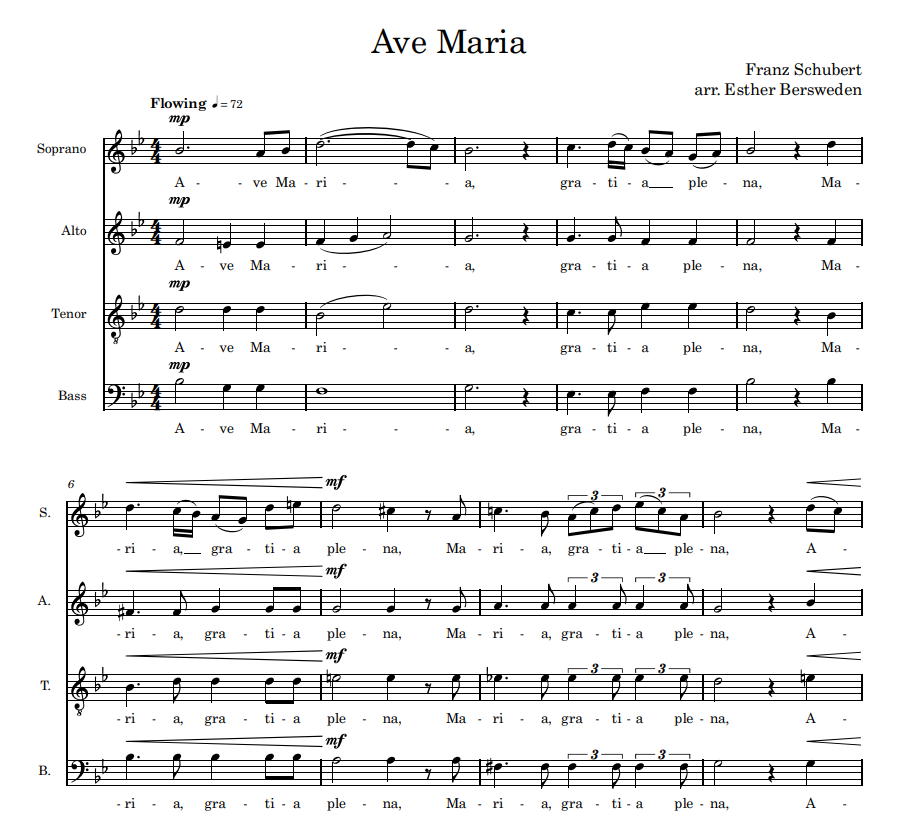
Ave Maria, gratia plena Dominus tecum; Benedicta tu in mulieribus, et benedictus fructus ventris tui, Jesus. Sancta Maria, Mater Dei, ora pro nobis peccatoribus, nunc et in hora mortis nostrae. Amen.
Hail Mary, full of grace, The Lord is with thee; Blessed art thou amongst women, And blessed is the fruit of thy womb, Jesus. Holy Mary, Mother of God, Pray for us sinners, Now and at the hour of our death. Amen.
Traditional
If you would like to perform this piece, please get in touch via the Contact page. I am happy to send perusal scores if interest is expressed.
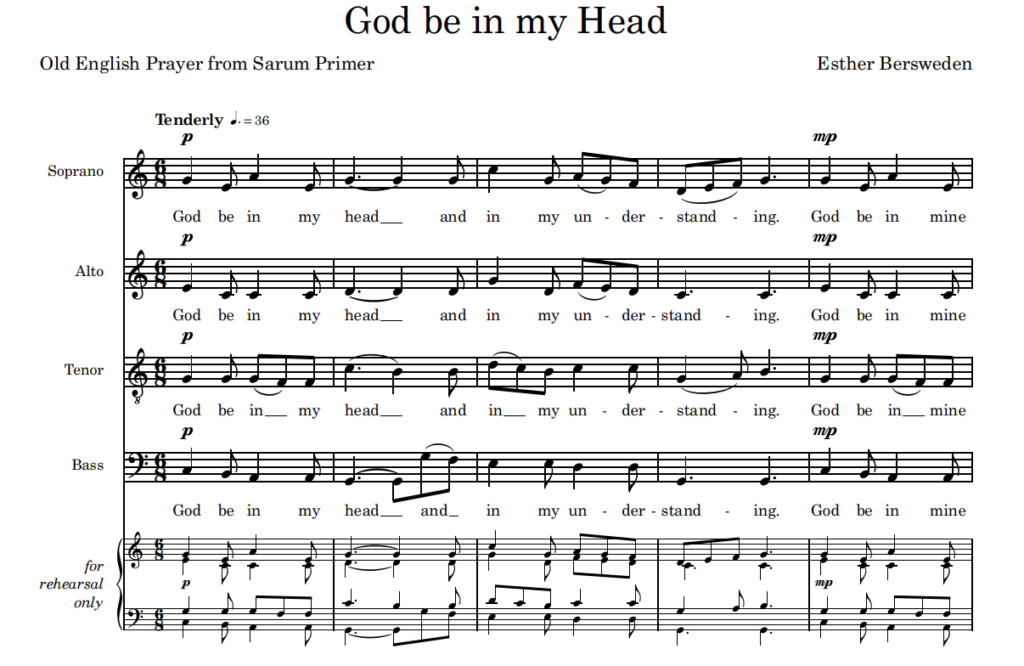
God be in my head and in my understanding. God be in mine eyes and in my looking. God be in my mouth and in my speaking. God be in my heart and in my thinking. God be at mine end and at my departing.
Richard Pynson’s Horae, 1514
If you would like to perform this piece, please get in touch via the Contact page. I am happy to send perusal scores if interest is expressed.
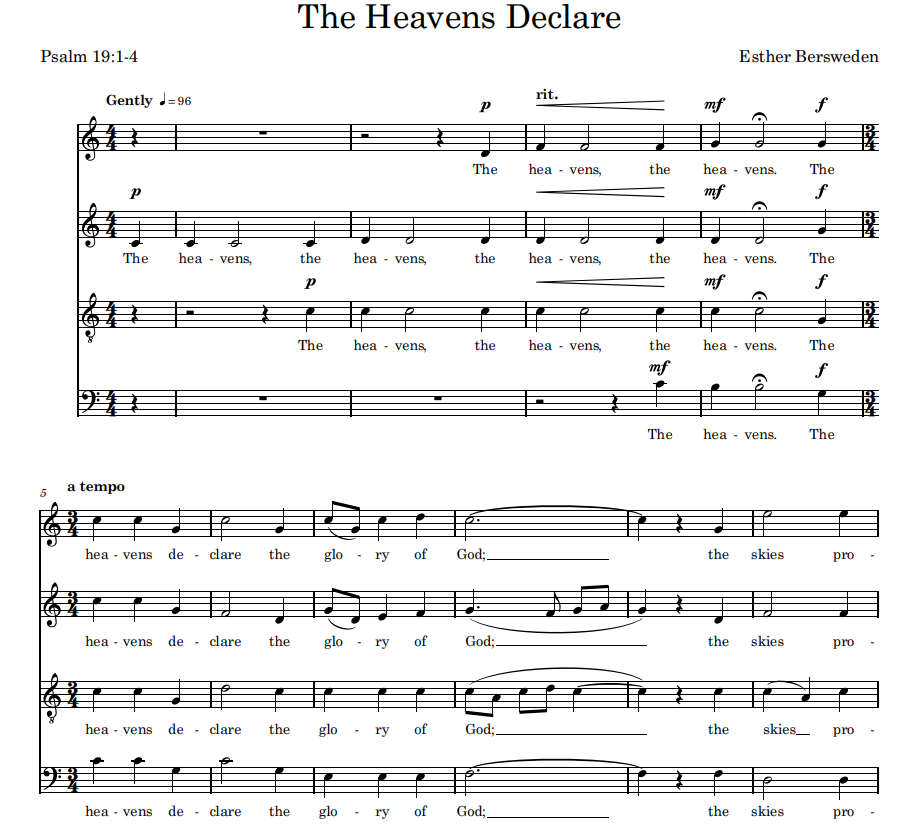
The heavens declare the glory of God; the skies proclaim the work of his hands. Day after day they pour forth speech; night after night they reveal knowledge. They have no speech, they use no words; no sound is heard from them. Yet their voice goes into all the earth, their words to the ends of the world.
Psalm 19:1-4
If you would like to perform this piece, please get in touch via the Contact page. I am happy to send perusal scores if interest is expressed.
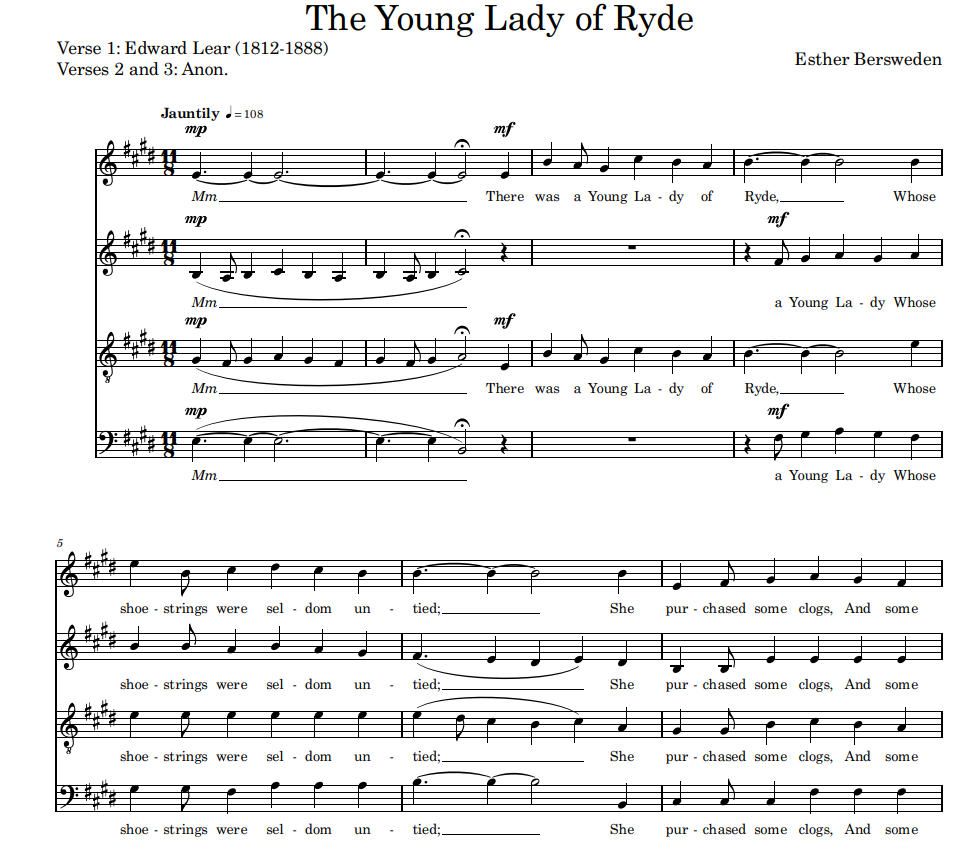
There was a Young Lady of Ryde, Whose shoe-strings were seldom untied; She purchased some clogs, And some small spotted dogs, And frequently walked about Ryde.
Edward Lear (1812-1888)
There was a Young Lady of Ryde, Who ate a sour apple and died; The apple fermented Inside the lamented, And made cider inside her insides.
Anon.
There was a Young Lady of Ryde, Who fell off the pier and died; A passing shark Was heard to remark: ‘I knew that the Lord would provide.’
Anon.
If you would like to perform this piece, please get in touch via the Contact page. I am happy to send perusal scores if interest is expressed.