Wisdom

SSA and Organ

c. 4’10”

Commissioned by Samantha Price, GSA President 2021-2022 & Headmistress of Benenden School, to mark the Heads’
Conference, Manchester, November 2021

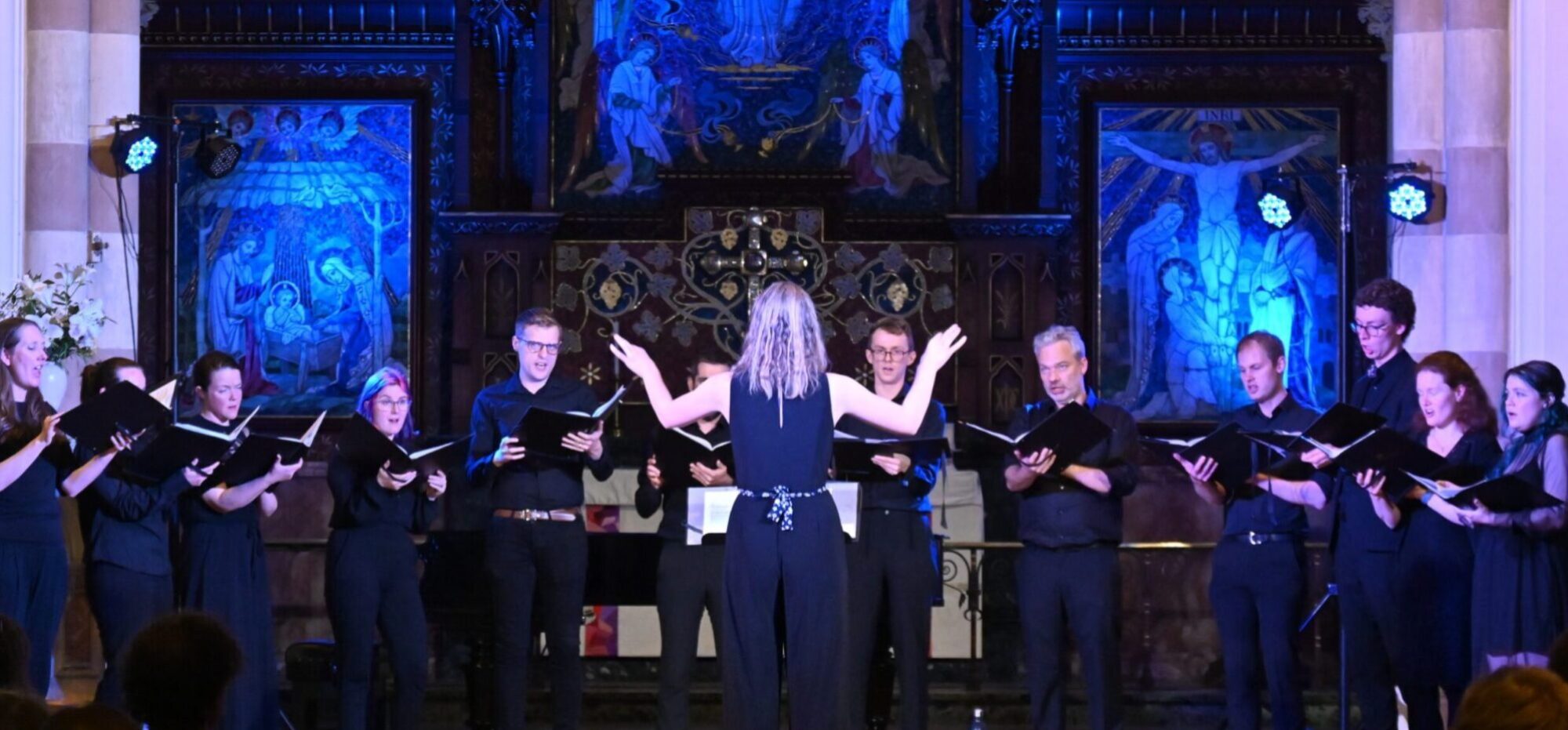
Performed by Benenden School Chapel Choir, directed by Edward Whiting, 2021

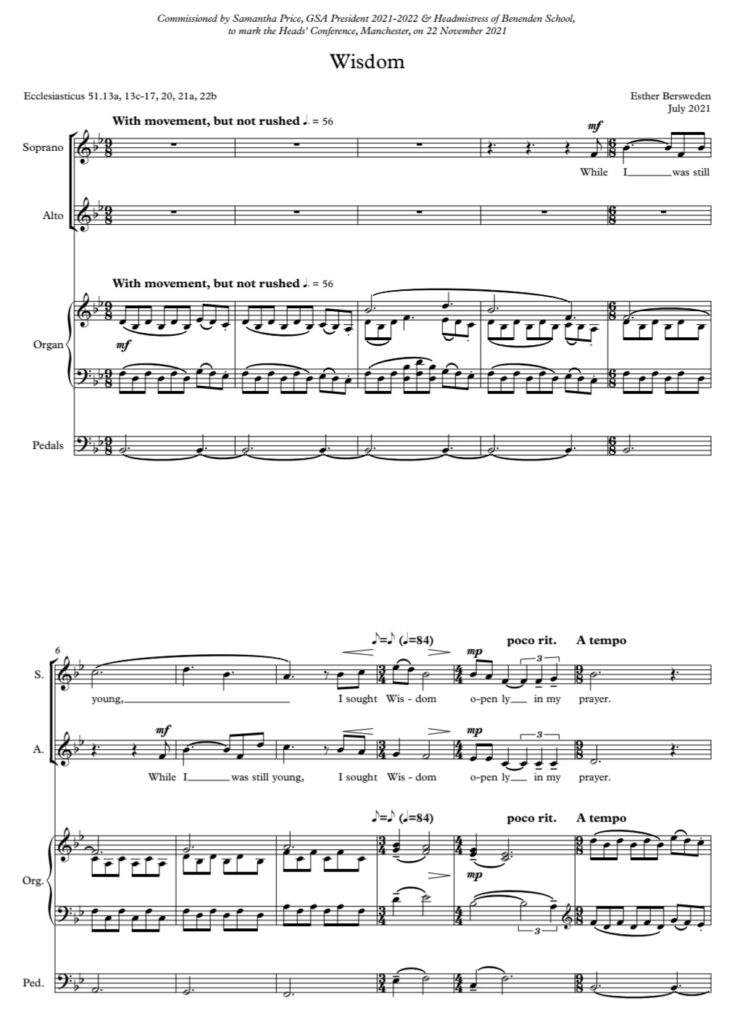
While I was still young, I sought Wisdom openly in my prayer.
Before the temple I asked for her, and I will search for her until the end.
From the first blossom to the ripening grape, my heart delighted in her.

My foot walked on the straight path, from my youth I followed her steps.
I inclined my ear a little and received her, I found for myself much instruction.
I made progress in Wisdom; to the One who sent her, I will give glory.

I directed my soul to Wisdom, and in purity have I found her.
With her I gained understanding from the first, therefore will I never be forsaken.
My heart was stirred to seek her, with my tongue will I sing God’s praise.

Ecclesiasticus 51.13a, 13c-17, 20, 21a, 22b

If you would like to perform this piece, please get in touch via the Contact pageI am happy to send perusal scores if interest is expressed.

Time and Tides VI: Even Such is Time

This is the sixth movement of Time and Tides, commissioned by Eltham Choral Society. Other movements can be found here:

SATB and Organ

c. 5’30”

Performed by Eltham Choral Society, directed by Max Barley, 2024. Organ: Matthew Jorysz

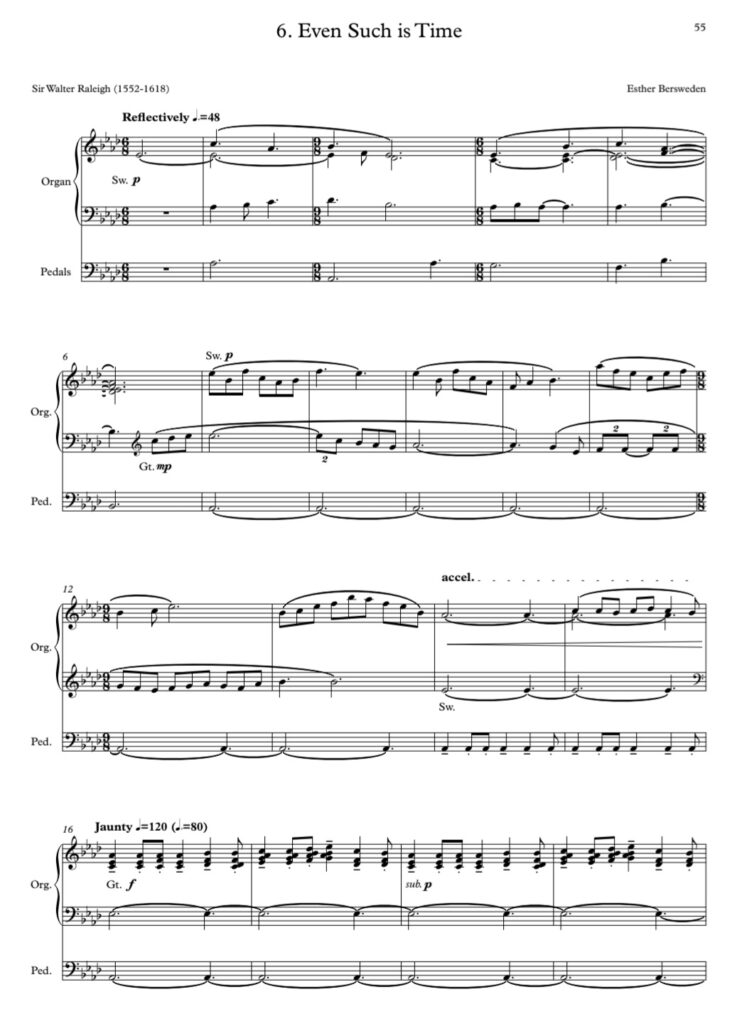
Even such is time, that takes in trust
Our youth, our joys, our all we have,
And pays us but with age and dust;
Who, in the dark and silent grave,
When we have wandered all our ways,
Shuts up the story of our days.
But from this earth, this grave, this dust,
My God shall raise me up, I trust.

Sir Walter Raleigh (1552-1618)

If you would like to perform all of Time and Tides or individual movements, please get in touch via the Contact pageI am happy to send perusal scores if interest is expressed.

Time and Tides V: When I Heard the Learn’d Astronomer

This is the fifth movement of Time and Tides, commissioned by Eltham Choral Society. Other movements can be found here:

SATB and Organ

c. 5′

Performed by Eltham Choral Society, directed by Max Barley, 2024. Organ: Matthew Jorysz

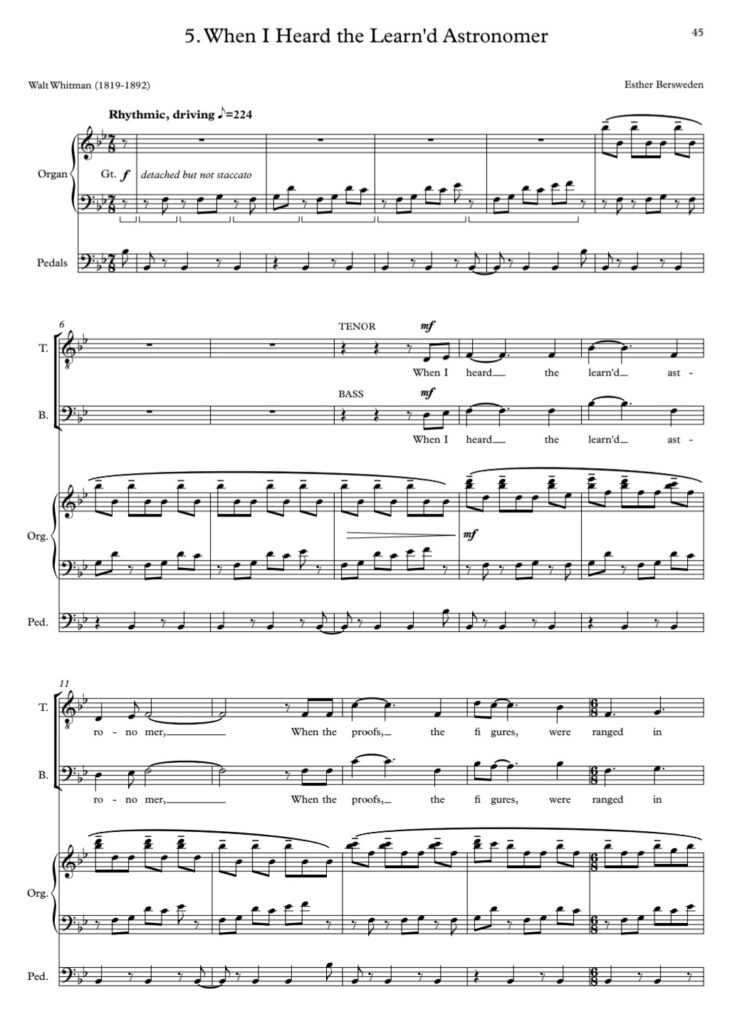
When I heard the learn’d astronomer,
When the proofs, the figures, were ranged in columns before me,
When I was shown the charts and diagrams, to add, divide, and measure them,
When I sitting heard the astronomer where he lectured
with much applause in the lecture-room,
How soon unaccountable I became tired and sick,
Till rising and gliding out I wander’d off by myself,
In the mystical moist night-air, and from time to time,
Look’d up in perfect silence at the stars.

Walt Whitman (1819-1892)

If you would like to perform all of Time and Tides or individual movements, please get in touch via the Contact pageI am happy to send perusal scores if interest is expressed.

Time and Tides IV: One Tree Hill

This is the fourth movement of Time and Tides, commissioned by Eltham Choral Society. Other movements can be found here:

SATB and Organ

c. 7’30”

In this movement, an unaccompanied verse of singing is followed by an Organ Interlude based on the opening melody.

Performed by Eltham Choral Society, directed by Max Barley, 2024. Organ: Matthew Jorysz

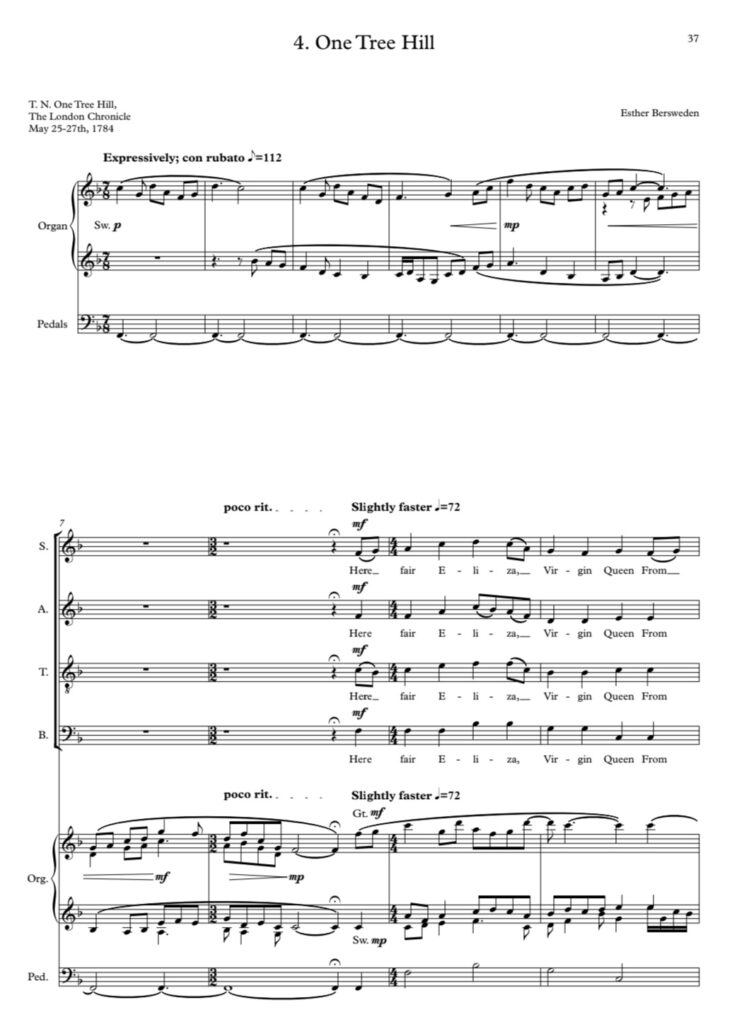
Here fair Eliza, Virgin Queen
From business free, enjoy’d the scene.
Here oft in pensive mood she stood
And kindly plan’d for Britain’s good:
So record tells and this beside,
Sung ditties to the silver tide
Full worth such honours art thou still,
Belov’d of thousands, One Tree Hill.

T. N. One Tree Hill, The London Chronicle
May 25-27th, 1784

If you would like to perform all of Time and Tides or individual movements, please get in touch via the Contact pageI am happy to send perusal scores if interest is expressed.

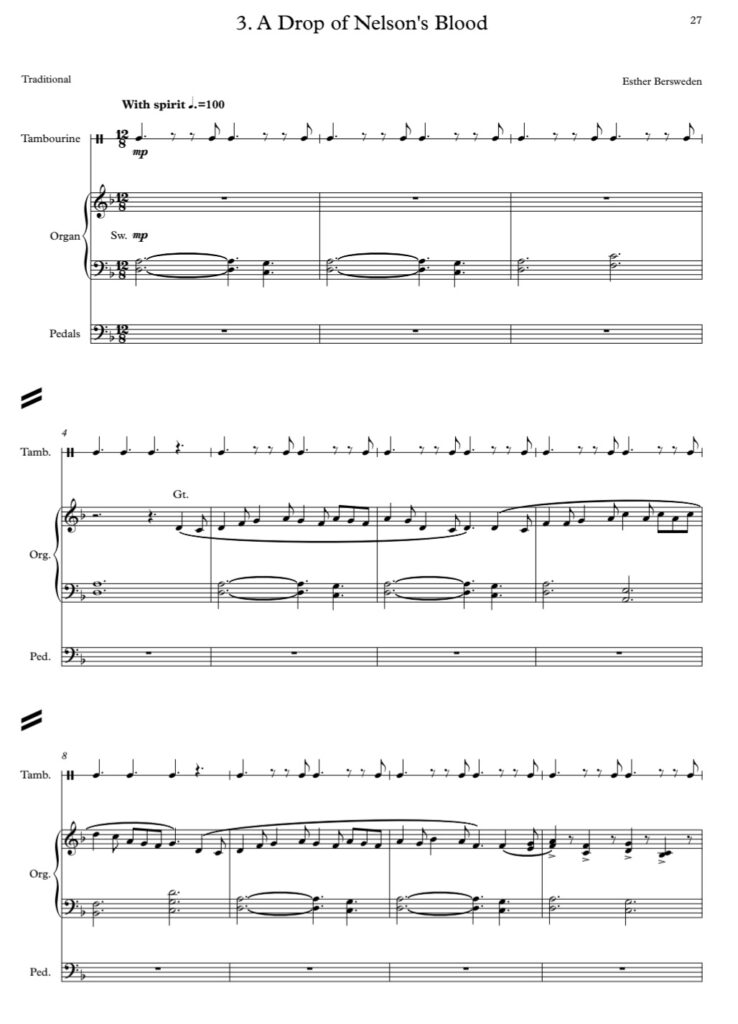
Time and Tides III: A Drop of Nelson’s Blood

This is the third movement of Time and Tides, commissioned by Eltham Choral Society. Other movements can be found here:

SATB and Organ, with optional Tambourine

c. 2’50”

Performed by Eltham Choral Society, directed by Max Barley, 2024. Organ: Matthew Jorysz. Tambourine: Josh Hutchinson

Oh, a drop of Nelson’s blood wouldn’t do us any harm,
And a drop of Nelson’s blood wouldn’t do us any harm,
And we’ll all hang on behind.

Come on and roll the old chariot along,
We’ll roll the old chariot along,
And we’ll roll the old chariot along,
And we’ll all hang on behind!

Oh, a bottle of rum wouldn’t do us any harm,
And a bottle of rum wouldn’t do us any harm,
And we’ll all hang on behind.

Come on and roll the old chariot along,
We’ll roll the old chariot along,
And we’ll roll the old chariot along,
And we’ll all hang on behind!

Oh, a drop of Nelson’s blood wouldn’t do us any harm,
And a drop of Nelson’s blood wouldn’t do us any harm,
And we’ll all hang on behind.

Come on and roll the old chariot along,
We’ll roll the old chariot along,
And we’ll roll the old chariot along,
And we’ll all hang on behind!

Traditional

If you would like to perform all of Time and Tides or individual movements, please get in touch via the Contact pageI am happy to send perusal scores if interest is expressed.

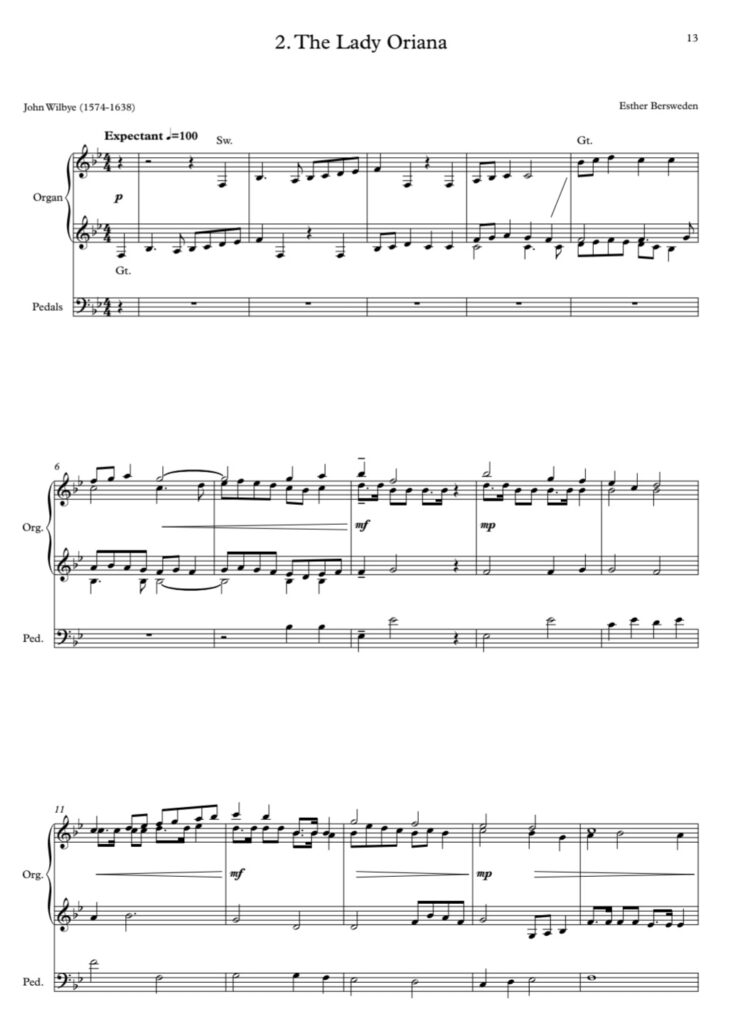
Time and Tides II: The Lady Oriana

This is the second movement of Time and Tides, commissioned by Eltham Choral Society. Other movements can be found here:

SATB and Organ

c. 5′

Performed by Eltham Choral Society, directed by Max Barley, 2024. Organ: Matthew Jorysz

The Lady Oriana
Was dight all in the treasures of Guiana;
And on her Grace a thousand Graces tended:
And thus sang they: Fair Queen of peace and plenty,
The fairest Queen of twenty.
Then with an olive wreath, for peace renowned,
Her virgin head they crowned:
Which ceremony ended,
Unto her Grace the thousand Graces bended.
Then sang the shepherds and nymphs of Diana:
Long live fair Oriana.

John Wilbye (1574-1638)

If you would like to perform all of Time and Tides or individual movements, please get in touch via the Contact pageI am happy to send perusal scores if interest is expressed.

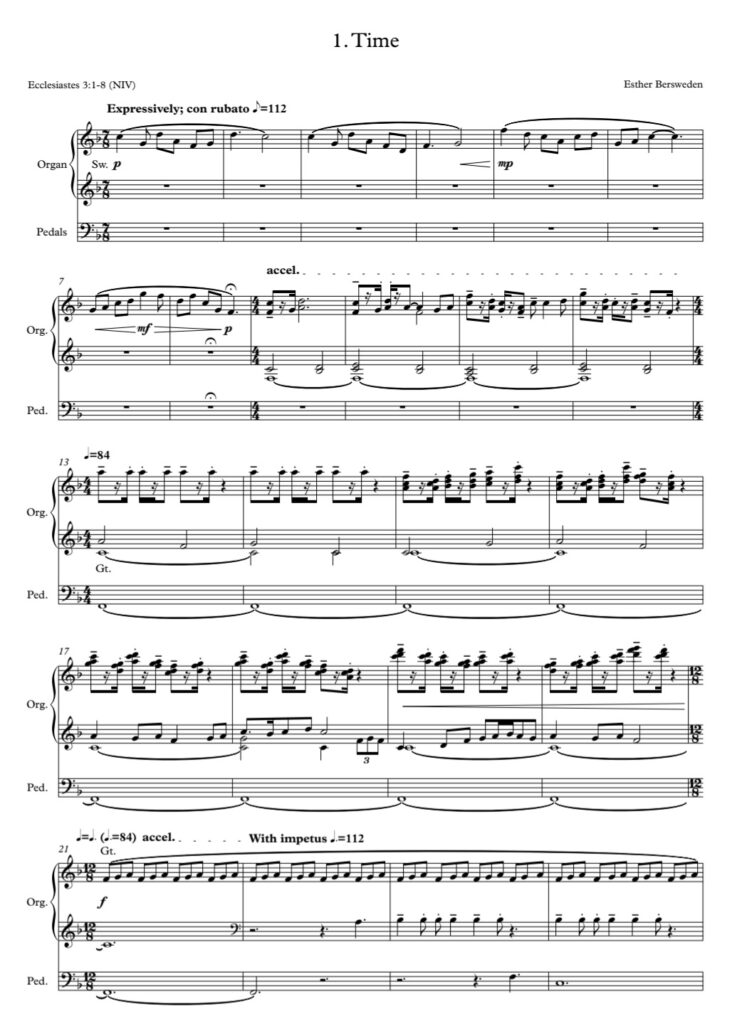
Time and Tides I: Time

This is the first movement of Time and Tides, commissioned by Eltham Choral Society. Other movements can be found here:

SATB and Organ

c. 6’30”

Performed by Eltham Choral Society, directed by Max Barley, 2024. Organ: Matthew Jorysz

There is a time for everything,
and a season for every activity under the heavens:
a time to be born and a time to die,
a time to plant and a time to uproot,
a time to kill and a time to heal,
a time to tear down and a time to build,
a time to weep and a time to laugh,
a time to mourn and a time to dance,
a time to scatter stones and a time to gather them,
a time to embrace and a time to refrain from embracing,
a time to search and a time to give up,
a time to keep and a time to throw away,
a time to tear and a time to mend,
a time to be silent and a time to speak,
a time to love and a time to hate,
a time for war and a time for peace.

Ecclesiastes 3:1-8 (NIV)

If you would like to perform all of Time and Tides or individual movements, please get in touch via the Contact pageI am happy to send perusal scores if interest is expressed.

Time and Tides

SATB and Organ

c. 32′

Time and Tides was commissioned by Eltham Choral Society, and they gave the premiere in July 2024 at St Alfège Chuch in Greenwich, directed by Max Barley and accompanied by Matthew Jorysz.

The work is an exploration of Greenwich, where Eltham Choral Society is based, and each movement takes a different Greenwich-related theme. There is also an overarching theme of time conveyed through both the texts and the musical motifs. In the first movement, one of the lines of text reads ‘a time to be born and a time to die’, and the subsequent movements play out this narrative, following a trajectory of themes from birth to death.

The second movement is about Queen Elizabeth I when she was a young ‘queen of twenty’. Queen Elizabeth I was born in Greenwich, so this movement represents birth/youth. The third movement is a sea shanty, a type of work song sung during monotonous, repetitive and rhythmic jobs on ships. This represents adulthood, as does the fourth movement which is again about Queen Elizabeth I, but when she was older and ‘plan’d for Britain’s good’.

The fifth movement is split into two distinct sections; in the first section, the studying/working aspect of adulthood is predominant. However, in the second section, it is as if the narrator of the poem has gained wisdom in his later adulthood. The sixth movement wraps up this trajectory: the text is about old age and death, yet it does not end sadly or uncertainly, but with very true faith and trust in God. Despite being about death, this movement, and thus the whole work, ends with a tangible feeling of peace and hope.

Throughout the piece, both rhythmic and melodic motifs have been used to represent the passage of time. The melodic motif, which is also sometimes used harmonically and is transposed depending on the key, sounds like a bell chime; and the rhythmic motif is the word ‘TIME’ spelt out in Morse code: _  ..  _ _  .

Individual movements, along with a short explanation of their Greenwich-related theme, can be found here:

I. Time: Time (Greenwich Mean Time)

The first and last movements bookend the music by both having time as their Greenwich-related theme. This strengthens the overarching theme of time, and allows the listener to arrive back at the opening theme but seen and felt in a different way.

II. The Lady Oriana: Royalty (Queen Elizabeth I)

‘The Lady Oriana’ refers to Queen Elizabeth I, who was born at Greenwich Palace. This movement makes use of a polyphonic style reminiscent of music from the Renaissance period; Thomas Tallis (1505-1585) was one of the most noted composers of his time, and he is allegedly buried in St. Alfège Churchyard.

III. A Drop of Nelson’s Blood: Maritime Links

Greenwich has a rich history of ties with the navy and the sea, playing host to the National Maritime Museum, the Old Royal Naval College and the Cutty Sark. Lord Nelson’s body lay in state in Greenwich Hospital for three days when he was brought back to England in 1805, making the choice of text for the sea shanty in the third movement an easy one: ‘A drop of Nelson’s blood wouldn’t do us any harm’.

IV. One Tree Hill: Nature (Greenwich Park)

The fourth movement combines the themes of nature and royalty. The text of this movement is about ‘Fair Eliza’ – once again referring to Queen Elizabeth I. This text is inscribed on a bench on One Tree Hill in Greenwich Park, with an expansive view across the city. Once the two verses of text have been sung, the organ takes over for a pastoral-like reflection on the melody which has been introduced by the choir.

V. When I Heard the Learn’d Astronomer: Astronomy (The Royal Observatory)

The Royal Observatory was established in 1675, making 2025 its 350th anniversary. This movement sets a poem by Walt Whitman (1819-1892) about an astronomer who, having spent too long inside a lecture room talking and learning about the stars and planets, goes outside to gaze at them in awe and wonder – experiencing them for himself.

VI. Even Such is Time: Time

Alongside its theme of time, the sixth movement has further links with Greenwich: the text was written by Sir Walter Raleigh (1552-1618), who held various political positions during the reign of Queen Elizabeth I. There is a statue of him near the Old Royal Naval College in Greenwich.
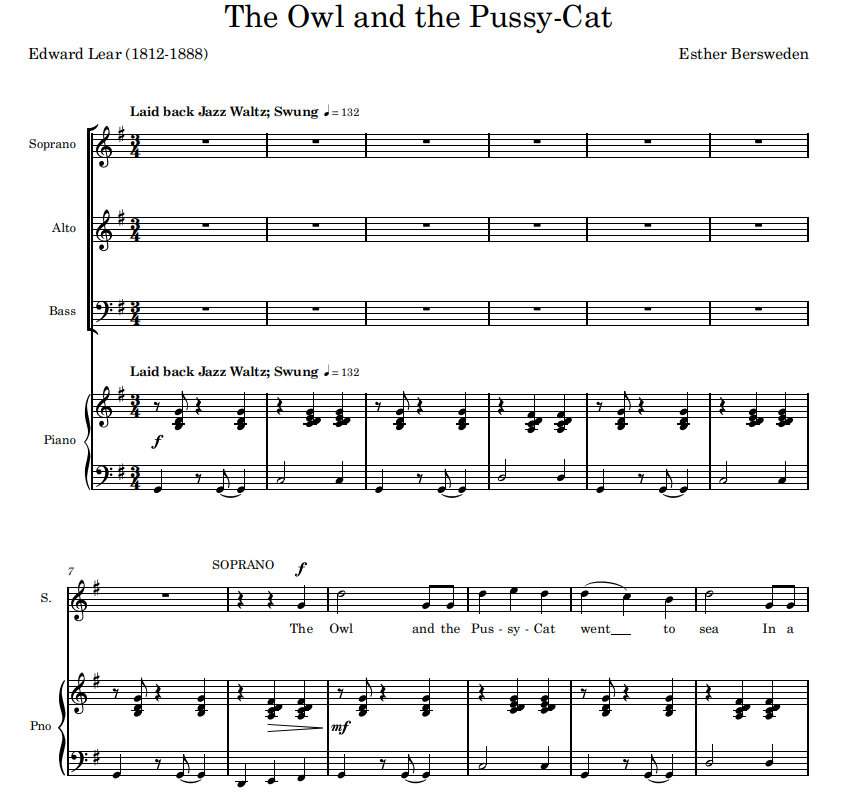
The Owl and the Pussy-Cat

This is the version for SAB. If you would like to see the versions for SSA or SATB, please click here:
SSA
SATB

SAB and Piano

c. 3’50”

The Owl and the Pussy-cat went to sea
In a beautiful pea-green boat,
They took some honey, and plenty of money,
Wrapped up in a five-pound note.
The Owl looked up to the stars above,
And sang to a small guitar,
“O lovely Pussy! O Pussy, my love,
What a beautiful Pussy you are,
You are,
You are!
What a beautiful Pussy you are!”

Pussy said to the Owl, “You elegant fowl!
How charmingly sweet you sing!
O let us be married! too long we have tarried:
But what shall we do for a ring?”
They sailed away, for a year and a day,
To the land where the Bong-Tree grows
And there in a wood a Piggy-wig stood
With a ring at the end of his nose,
His nose,
His nose,
With a ring at the end of his nose.

“Dear Pig, are you willing to sell for one shilling
Your ring?” Said the Piggy, “I will.”
So they took it away, and were married next day
By the Turkey who lives on the hill.
They dined on mince, and slices of quince,
Which they ate with a runcible spoon;
And hand in hand, on the edge of the sand,
They danced by the light of the moon,
The moon,
The moon,
They danced by the light of the moon.

Edward Lear (1812-1888)

If you would like to perform this piece, please get in touch via the Contact pageI am happy to send perusal scores if interest is expressed.

The Owl and the Pussy-Cat

This is the version for SATB. If you would like to see the versions for SSA or SAB, please click here:
SSA
SAB

SATB and Piano

c. 3’50”

The Owl and the Pussy-cat went to sea
In a beautiful pea-green boat,
They took some honey, and plenty of money,
Wrapped up in a five-pound note.
The Owl looked up to the stars above,
And sang to a small guitar,
“O lovely Pussy! O Pussy, my love,
What a beautiful Pussy you are,
You are,
You are!
What a beautiful Pussy you are!”

Pussy said to the Owl, “You elegant fowl!
How charmingly sweet you sing!
O let us be married! too long we have tarried:
But what shall we do for a ring?”
They sailed away, for a year and a day,
To the land where the Bong-Tree grows
And there in a wood a Piggy-wig stood
With a ring at the end of his nose,
His nose,
His nose,
With a ring at the end of his nose.

“Dear Pig, are you willing to sell for one shilling
Your ring?” Said the Piggy, “I will.”
So they took it away, and were married next day
By the Turkey who lives on the hill.
They dined on mince, and slices of quince,
Which they ate with a runcible spoon;
And hand in hand, on the edge of the sand,
They danced by the light of the moon,
The moon,
The moon,
They danced by the light of the moon.

Edward Lear (1812-1888)

If you would like to perform this piece, please get in touch via the Contact pageI am happy to send perusal scores if interest is expressed.